He was born on February 11, 1942, in Halle / Saale, Germany and fascinated by drawing and painting from an early age, since his mother was a graphic artist who earned a side income illustrating children’s books in post-war Germany. In high school Buechting, at age 16, won a scholarship in an automotive design competition from Opel, the German division of General Motors.. There was only one catch. The scholarship, which granted four semesters at Art Center College, the foremost college for transportation design in those days, had to be redeemed on location in Los Angeles. Realizing that earning the funds for his day-to-day living there and studying at the same time would be more than a full-time job would leave no time to get to know the world, Buechting decided to travel to the United States the long way. He hitch-hiked through North Africa, the Middle East, India, Thailand and Japan, crossing large bodies of water as a temporary deckhand. In Japan he paused for seven months, spending most of the time at a Zen monastery where he gained insight into Japanese esthetic sensibilities as well as classic painting and printing techniques. This compressed period of learning about concepts of “perfect imperfection“ and “studied abandon“ profoundly shaped Buechting’s understanding of meticulous workmanship and reductive, appropriate design, this mostly deliberately infused with an element of imbalance in hue or weight.
That attitude certainly was an asset during Buechting’s first course of study in transportation design at Art Center. At night he worked conventionally to cover his living expenses by running a printing shop for a large insurance company in Los Angeles, allowing him eventually to acquire the skills of a master printer. Upon graduation with honors, he decided that working in a corporate matrix for one of the Big Three auto makers in Detroit was not going to be his chosen path. Together with two fellow graduates he started a small graphic design office in Orange, California. While the company thrived, after two years the fundamentally different interests of the partners became increasingly apparent and Buechting left the group. Soon thereafter he started an advertising agency, “Basso / Buechting“, right across from Mac Arthur Airport in Irvine, California. This convenient constellation allowed him to escape on weekends to San Francisco where he maintained the base for his “other life“, namely a well-equipped studio. There he could paint and construct works that had to pay no attention to any commercial considerations.
In 1980 Jan Buechting started yet another company, this time in Boston and the commercial focus was on marketing and branding. After hours the artist immersed himself in work devoid of any practical and image concerns demanded by his clients. Thus, in his private oeuvre, he was not only to manifest his Asian inspired spatial sensibilities, his choice of spare, broken color elements but at the same time he had a chance to demonstrate his uncanny precision in the execution of hard-edge lines, complex curves, and magic shapes. In his figurative work there was (and is) the prevalent use of automotive and human body sections, drawings, advertising graphics, and photographic bits (often generated by the artist for a specific application and frequently manipulated by the use of an old fashioned repro-camera), subsequently arranged on carefully delineated axes, in mathematically figured weights, and finally applied on two and three dimensional surfaces with superb craftsmanship.
In 1981, when Buechting obtained his MFA at the Hartford Art School, in his own words, “for fun and some social enrichment”, his mentors recognized his years of professional experience and encouraged him to teach final semester undergraduate classes, thereby sharing some commercial survival skills with the next generation of art school graduates. This proved to an excellent practice for his later efforts in the U.S. Virgin Islands, where he addressed non-existent learning opportunities in that Caribbean region with practical hands-on graphics instruction in his studio. Such philanthropic motivation redirected Buechtings activities into the post-reunification Berlin area where he was quick to start another business entity, this time an agency as a vehicle for cultural and economic development projects. His efforts were concentrated on helping a number of venerable cultural institutions, among these were the world famous Bauhaus-Dessau, but also theater and ballet companies, archives and collections all struggling after forty years of socialism with necessary adjustments to a free market economy.
While working at the historical Bauhaus in Dessau (now a foundation and on the list of UNESCO’s world cultural heritage sites), a circle of trusted friends, which included Buechting as an initiator, saved one of the town’s largest former industrial complexes, formerly one of Germany largest breweries, then shuttered, from demolition.
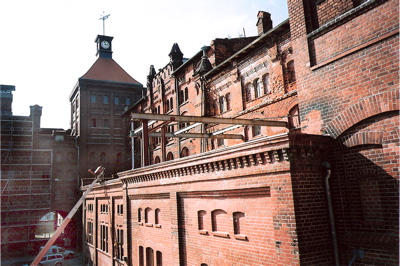
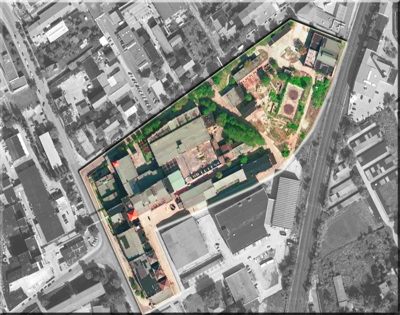
They discovered much hidden beauty and potential in the 320,000 square foot red brick medley of factory buildings dating back to 1869 and after arduous, two-year negotiations, bought it for a symbolic token amount from the owners. The “Brauhaus-Dessau” became one of the largest urban renewal projects in that mid size East German city.
(www.brauhaus-dessau.de) Today, after ten years of countless fundraising activities and subsidized task projects, the equivalent of more than six million Dollars have been invested into the project and half of the total square footage is now rehabilitated. The brewery (“Brauhaus”) is now a lively center, housing archives and restoration shops of two UNESCO-recognized institutions, the workshop and stage decorations storage of the Saxony-Anhalt State Theatre, the state’s tallest straight wall climbing sport facility, and a separate wing for a dozen start-up entrepreneurial businesses. There is a studio theatre for up to 800 spectators (that features everything from medieval consorts to Zen monk drumming), a large exhibit space, a pub and function space, soon a huge skater’s course will be completed. Naturally, studio spaces for everybody from Russian-Jewish dance groups to a number of experimental musicians and artists have been created. Soon, an innovative system of solar-paneled roofs in combination with huge rain water cisterns (serving as long tem heat sinks) will help heating the compound in winter. Here, Jan Buechting, without pulling rank as the vice chairman of the entire venture, pays rent as a regular tenant for his spacious European studio.
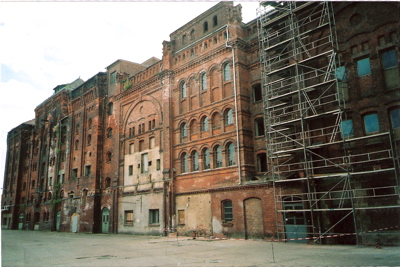
The name “Brauhaus” as a parallel and near-homonym to “Bauhaus” is fully intended: In the twenties and early thirties, during its peak, the Bauhaus - just down the street - managed to assemble and fuse an incredible creative and artistic power under one roof, this through the exhausting efforts and the diplomacy of its charismatic leaders. It is the hope of a troupe of tireless volunteers, which includes Buechting, that some day perhaps the Brauhaus will be another “reactor of ideas” where such creative and productive critical mass will initiate a new, different, but equally positive and peaceful chain reaction, totally on its own, without studied and managed intervention.
The present plan is that Buechting’s own art as well as his collection of paintings, sculptures, and books traded with friends and colleagues, his graphic archives, and his library will eventually be housed in a dedicated gallery within this compound.
If things proceed according to plan the Brauhaus will eventually be organized as a foundation and thereby be equipped to take possession of this and other intended donations. Buechting, who is presently sharing his time between living and working in Brookline, Massachusetts, and Europe will try to jettison as much of his distractions (outside of his family and the "Brauhaus-project", of course) in order to devote as much time to his art as is still left on his wartime rationing card issued on February 11, 1942.
Pamela Cabell-Whiting, PhD.